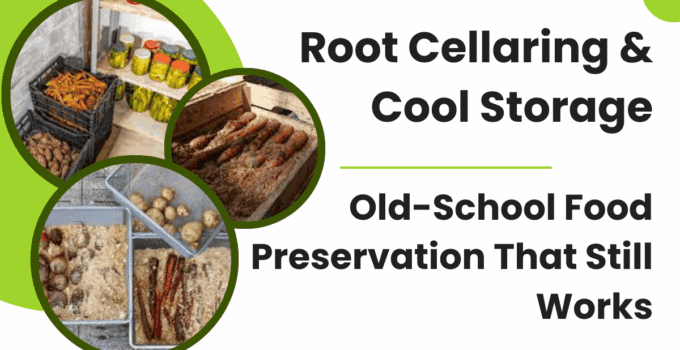
Root Cellaring – Before freezers, canners, and dehydrators, there was the root cellar—a cool, dark space that could keep fruits and vegetables fresh for months with no electricity. And while not every homesteader has a true root cellar dug into a hillside, there are plenty of ways to adapt the concept and enjoy low-tech food storage that really works.
🧊 What Is Root Cellaring?
Root cellaring relies on natural insulation, humidity, and steady cool temperatures (ideally 32–50°F with 85–95% humidity) to slow down the spoilage process and keep certain crops fresh long after harvest.
No heat, no canning, no freezing—just strategic storage.
🥕 Best Crops for Root Cellaring
Root cellaring isn’t for everything—but for the right produce, it’s a game-changer.
Store Well in Cool, Damp Conditions:
- Carrots (packed in sand or sawdust)
- Beets
- Turnips
- Rutabagas
- Parsnips
- Cabbage
Store Well in Cool, Dry Conditions:
- Potatoes
- Winter squash
- Onions
- Garlic
- Sweet potatoes
Other Possibilities:
- Apples (store away from potatoes to avoid premature sprouting)
- Pears (short-term)
- Celeriac


🏠 How to Set Up a DIY Root Cellar (or Cool Storage Space)
You don’t need a cave or hillside. Here are some modern workarounds:
Root Cellaring – Option 1: Basement or Crawlspace Cellar
- Use bins, shelves, or crates
- Monitor temperature and humidity
- Create damp/dry zones with sand or straw
Root Cellaring – Option 2: Buried Coolers or Barrels
- Dig into a shaded spot and bury a lidded container
- Line with straw or sawdust
- Add ventilation if possible
Root Cellaring – Option 3: Unheated Garage or Shed
- Works in milder climates or during winter
- Store crops in insulated coolers or wooden boxes
- Watch for freezing temps
Root Cellaring – Option 4: Fridge Cellar
- Dedicate a second fridge (on low setting)
- Store apples, carrots, or cabbage in bags or containers
🧼 Storage Tips for Success
- Harvest carefully—don’t bruise or nick produce.
- Don’t wash root crops before storing—brush off loose dirt instead.
- Inspect often—remove anything soft or rotting immediately.
- Maintain humidity: line crates with damp burlap or use trays of water.
- Keep rodents and pests out—use tight containers if needed.
📋 BONUS RESOURCE: Storage Conditions by Crop
| Crop | Temp (°F) | Humidity | Notes |
|---|---|---|---|
| Carrots | 32–40 | High | Store in damp sand or sawdust |
| Potatoes | 40–45 | Medium | Keep in the dark to prevent greening |
| Onions & Garlic | 32–50 | Low | Dry thoroughly before storing |
| Apples | 30–35 | High | Wrap in paper to prevent contact rot |
| Squash | 50–55 | Low | Cure first, then store dry |
🧄 Final Thoughts
Root cellaring is about working with nature instead of against it. Whether you go full-on underground bunker or just tuck a bin of carrots into your basement, cool storage adds another layer of food security and simplicity to your homestead.
Next Up: Preserving Herbs – Drying, Freezing, and Infusing
From hanging bundles of rosemary to freezing basil in olive oil, the next article explores all the ways you can preserve herbs for cooking, medicine, and more.
A Life on the Farm is beginning a new series of farm fresh food preservation ideas! We just completed a series of informational and instructional posts concerning various aspects of much needed cooking skills. Check them out and be sure to subscribe and come back for that and more!
MORE WAYS TO CONNECT
We also, as a homesteading family, have a variety of blogs that might interest you. A Life on the Farm focuses on the more personal side of the homesteading life. We discuss subjects like family, parenting, relationships, homeschooling, cooking, canning and so much more.
Two Oaks Farm Talk concerns the more technical side of homesteading. We discuss subjects like gardening, food prep, and farm building and construction with lots of tutorials!
Farm Raised Family is basically a hub for everything under the Two Oaks Farmstead umbrella. You can learn a great deal about all parts of the farmstead there. The Farm Raised Family blog focuses on financial matters such as budgeting, saving, and more and on current events affecting families.
You can also have a more in depth look at all that we do by visiting our Two Oaks Farmstead YouTube Channel and be sure to subscribe so that you don’t miss a thing!
Farm Life and Freedom is the new podcast we are in the process of launching! It is going to be so much fun! You could also check in with our Farm Life and Freedom Youtube Channel.
Two Oaks Farmstead is the farm store… the one that holds the umbrella! Check us all out and join us, not only on our blogs and Farm Life and Freedom podcast but come join the fun on Facebook, Instagram, Twitter… wherever you get social!